This year has been quite a ride for crypto which doesn't stop but only gets faster. Based on the stats on the internet, the crypto market cap is over $3 Trillion. The NFT market cap is $43 Billion. For comparison, Tesla's market cap is $1.07T, and Meta's is $921B.
NFT.NYC
I signed up for speaker at NFT.NYC early this year because the ticket is free and I wanted to practice public speaking in English. While the conference is quite un-organized, and I was staying in the hotel most of the time, I was still mind-blown by the energy at NFT.NYC. Few things I learnt:
- Digital art is a small part of NFT. Value is in the technology.
- Lots of people from different fields: artists, mathematicians, architects, actors, developers, commodity traders, investment bankers, stockbrokers, hedge fund people, etc.
- Many companies are starting to build Metaverse, such as Decentraland, Sandbox, etc.
- The history has started.
My NFT journey
I have read through Satoshi's original Bitcoin white paper and I was fascinated by the beauty of the algorithm. Even though I strongly believed in the science behind blockchain, I didn't get into cryptocurrency because the adoption was rather small and not enough people believed in it. I did buy Bitcoin because I see it as digital gold. Now as blockchain-based technologies are getting traction, they can be applied to more and more use-cases.
When I learnt about NFT early this year in April, I was astonished by how impactful the technology can be once widely adopted.
- Non fungible tokens could be mapped into the ownership rights of any item in the real world — real estate ownership, intellectual property rights, tickets and of course — ownership of arts.
- One of the great benefits of NFTs is the ease of token transfer and authentication.
- To give an example — let's imagine that someone wants to sell a Mona Lisa painting. Currently, there are thousands of copies of this masterpiece. Everyone can view, download or copy an image of the painting. In terms of the content, copies are just as good as the original. But it is not the content itself that carries a value. It is the uniqueness of the original item that we believe to be of value. This is exactly what NFTs can be used for — to represent ownership of a unique digital item.
- It requires a staff of qualified people to verify the authenticity of the Mona Lisa painting. With NFTs, token authentication comes out of the box and is of no concern to users.
- Transfer of the physical painting is also quite risky, expensive and a time-consuming process. It is not trivial to transfer a very fragile, unique item across the world. Tokens can be transferred in a matter of hours or even minutes.
I bought my first NFT on Nifty Gateway in April. Out of boredom, I also recorded a NFT video. (Sorry, it's in Mandarin.) I have also created my own trading script based on the buy/sell volume. I have an analogy: NFT collection token number (stock share) * average price = Artist's market cap (company stock market cap).
This is one NFT's price and volume over time. Quite interesting to see how they match.
Soon, I stopped trading because it's time consuming. I spent more time enjoying digital art and learning about the technology. I listened to a lot of podcasts. The most important one to me is Lex Fridman's interview with Silvio Micali, who is a computer scientist at MIT, Turing award winner, and founder of Algorand. (Btw, I highly recommend Lex's podcasts.) And later, what helped me understand this blockchain economy is the course from MIT by Gary Gensler who is the chairman of U.S. SEC now.
Best Chain?
NFT != cryptocurrency. NFT is built on top of blockchain. But what chain should we bet on? Ethereum, Cardano, Algorand, Bitcoin? Will there be a perfect chain that will rule them all and become "The Chain"?
Most probably not. There are many aspects that characterize a blockchain.
- One of them is environmental impact.
- Each blockchain transaction needs computation power, just like standard money transfers are processed on computers owned by financial institutions, blockchain transactions are processed on machines participating in the chain. Computation power required to process a transaction is proportional to the electricity cost and therefore — carbon footprint contribution.
- Scalability is how well the system performs when there are a lot of people using it. It is not an easy task to design a system that will be working fast on a planetary scale.
- Developability tells us how easy it is for contributors to develop features on the chain.
- Governance defines a system for managing and implementing changes to cryptocurrency blockchains.
- Applicability and Interoperability describe how easy it is to apply the chain to solve the existing problems and how easy it is to integrate it with other systems.
Without diving further in the technical details, the answer to the "best chain" question is short. There is not a best chain. You can never have it all. All blockchain protocols come with trade-offs that we should be aware of when selecting it for our use-case.
Web 3.0
This figure shows the evolution of web applications, starting with static content web applications.
In 2005, Meta, Google and other players began a trend of creating interactive web applications. This was followed by a natural move from computer internet browsers to mobile applications. In recent 10 years, subscription based streaming services are thriving.
A 5 yo kid nowadays is getting knowledge from youtube and taking classes on Zoom. Information is no longer only text and pics but also videos.
Many of my friends and I believe that the main purpose of the internet is to communicate information faster and easier. Since 1989, we can see some changes:
- Platform change: yahoo, facebook, netflix, dapps
- Content change: text, pics, videos, ar, vr
- Equipment change: pc, mobile, wearables, IoT, 5G
I can see two trends in the last few decades:
- We have more interactions on the internet now. Covid pushed us to have the need to be connected virtually.
- People start to spend more money on the internet, and agree with the value of digital content. You can buy subscriptions, classes, podcasts. Influencer is a real job.
And we think Blockchain technology enables web 3.0, a pure decentralized application.
Network is becoming an economy. Historical big change is compounded, exponential. It doesn't happen overnight. It's not clear when you are there because you are at one spot in this curve. But when you look back, I think the golden age for Web 3.0 is now.
Metaverse
It is hard to talk about NFTs without talking about Metaverse.
Metaverse definition is ambiguous as the term is still being coined. The idea behind it is to connect all three layers mentioned in the previous section:
- New hardware: Wearables, IoT
- New content: Augmented Reality, Virtual Reality
- New platform: Blockchain and Distributed Applications (dApps)
To me, Metaverse looks something like:
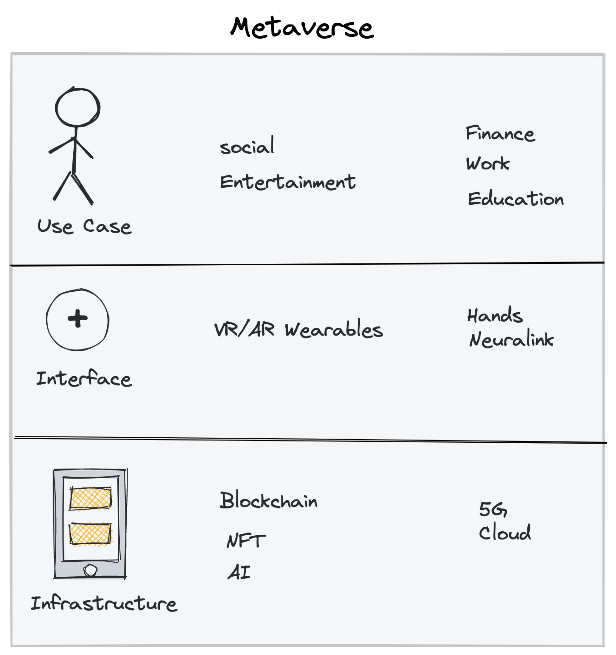
But what is the role of NFT here and how does it empower artists and other content creators?
Metaverse will introduce an entire new economy of digital goods — from models of 3D objects for VR applications to avatars, music and paintings. NFT is the central point of such economy. Technology of non-fungible tokens enables a secure, reliable and open exchange of any digital goods. Having those tools at their disposal, artists can monetize their work much easier.
Final words
Time will calm the market, and make the product mature. I believe Metaverse is about the creativity economy and this will encourage more creativity between creators, developers, business and end users. I am excited to witness and join this journey.
Some photos I took at the conference: